
Sciatica vs Hip Pain: How To Tell the Difference
Important: The information in this article is for education only and is not a substitute for a medical evaluation, diagnosis, or treatment. If you have pain or other concerning symptoms, please see a qualified healthcare professional such as a physical therapist or physician.
If you feel pain around your hip, buttocks, or down your leg, it can be hard to know whether you’re dealing with “sciatica” or a true hip problem. Both can interfere with walking, standing, or sitting, but they come from different sources and respond to different treatments.
I’m Dr. Vardhan Kumar Mudigonda, PT, DPT, physical therapist and owner of Physical Therapy & Wellness by Design (PTWD) in Clarksburg, Maryland. I often see people who have been told they have sciatica when the real issue is their hip, and vice versa. This guide explains key differences in simple language so you can have a more informed conversation with your healthcare provider.
Quick Overview: Sciatica vs Hip Pain
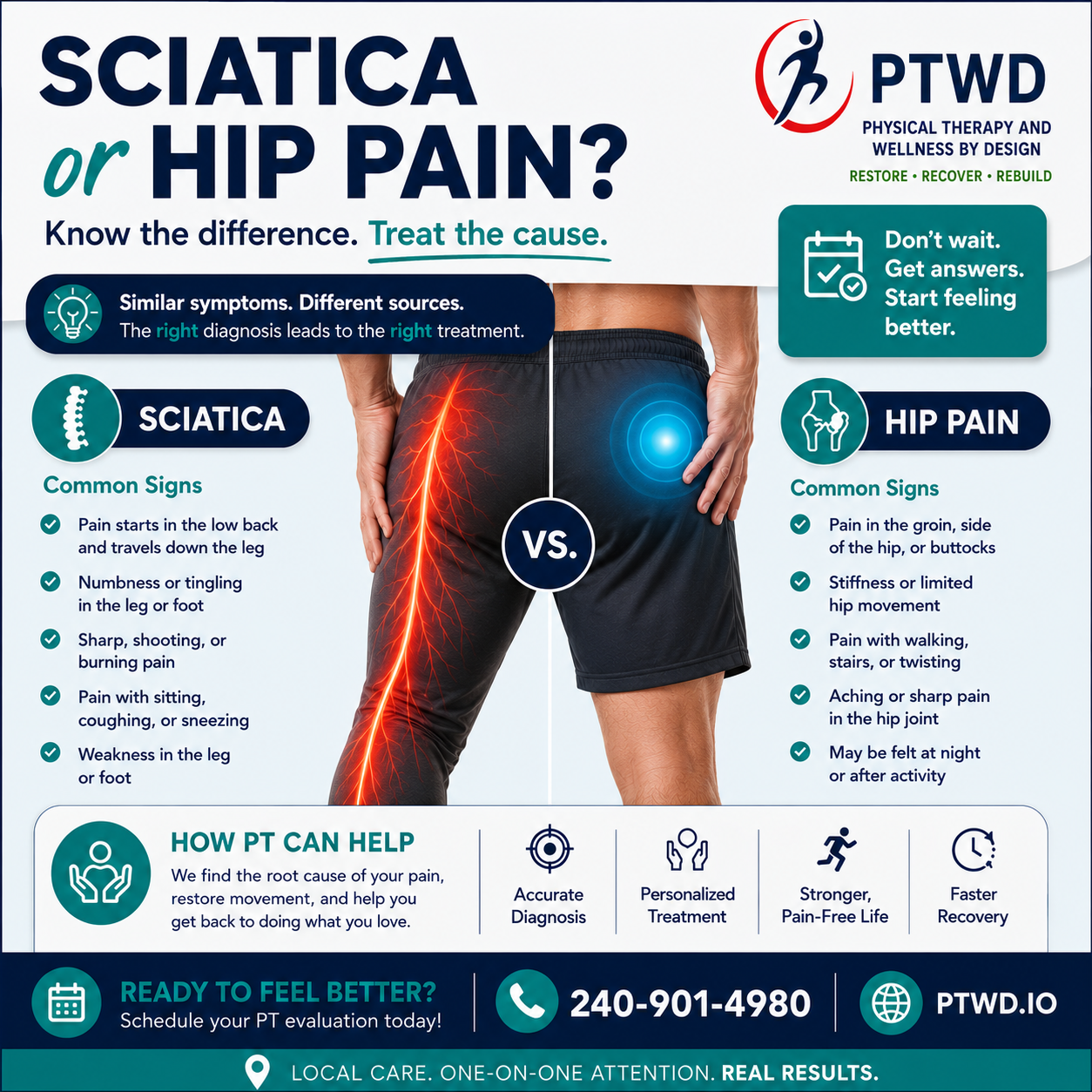
Sciatica is irritation of the sciatic nerve, usually starting in the lower back and traveling through the buttock and down the leg.
Hip pain usually comes from the hip joint or nearby muscles and tendons and is often felt in the groin, front of the hip, or side of the hip.
One simple way to think of it: sciatica is more of a “nerve/wiring” problem, while hip pain is more of a “joint and muscle” problem.
What Is Sciatica?
The sciatic nerve starts in your lower back, runs through your buttock, down the back of your thigh, and into your lower leg and foot. Sciatica happens when that nerve is irritated or compressed.
Common causes include:
A disc bulge or herniation in the lower back
Spinal stenosis (narrowing of the spinal canal)
Arthritis or degenerative changes in the spine
Tight or overactive deep hip muscles (for example, the piriformis)
Because the problem involves a nerve, the pain can travel anywhere along its path.
What Does Sciatica Feel Like?
Typical sciatica symptoms include:
Pain that starts in the lower back or buttock and radiates down the leg
Pain that often travels below the knee, sometimes into the foot
Sharp, shooting, burning, or electric‑like pain
Numbness, tingling, or weakness in the leg or foot
Usually affects one side of the body
Often worse with prolonged sitting, bending forward, coughing, or sneezing
People often describe it as “a lightning bolt down my leg” or “pain that shoots when I move a certain way.”
What Is Hip Joint Pain?
When we talk about hip pain in a medical sense, we usually mean the ball‑and‑socket joint where your thigh bone meets your pelvis, or the surrounding soft tissues.
Common causes of hip pain:
Hip osteoarthritis (wear and tear of the joint)
Labral tears or hip impingement
Bursitis
Tendinitis of the hip muscles
Muscle strains or overuse
Here, the source is local to the joint or nearby tissues, so the pain pattern is more focused than sciatica.
What Does Hip Pain Feel Like?
Typical hip pain symptoms:
Pain in the front of the hip or groin (very common with hip arthritis and labral issues)
Pain on the side of the hip or outer thigh, especially lying on that side
Aching in the buttock or upper thigh
Stiffness and reduced range of motion, especially with walking, getting out of a car, or putting on shoes and socks
Pain that worsens with weight‑bearing activities like walking, standing, or going up stairs
Sometimes clicking or catching sensations in the hip
People with hip joint problems often point to their groin or front of the hip with their whole hand.
Sciatica vs Hip Pain: Key Differences
Here are some quick ways to tell them apart:
Location of pain
Sciatica: Starts in the low back or buttock and travels down the back of the thigh, often below the knee.
Hip pain: Often in the groin, front of hip, or side of hip; may refer to the buttock or upper thigh but usually stays closer to the joint.
Type of pain
Sciatica: Sharp, shooting, burning, electric; may include numbness or tingling.
Hip pain: Deep, aching pain, sometimes sharp with specific movements; tingling and numbness are uncommon.
What makes it worse
Sciatica: Sitting, bending, twisting, coughing, sneezing.
Hip pain: Walking, standing, stairs, lying on that side, or rotating the leg.
Movement limits
Sciatica: Back movements and nerve‑tension positions (like straightening the leg) often reproduce symptoms.
Hip pain: Hip‑joint movements—crossing legs, rotating the leg, putting on shoes—often bring the pain on.
Can Sciatica Cause Pain in the Hip Area?
Yes. Sciatica can be felt in the buttock or hip region because the nerve passes through that area. Hip problems can also cause pain there, which is why it can be confusing.
A few simple clues:
If the pain travels down the leg and feels sharp or electric, sciatica is more likely.
If the pain stays localized around the hip or groin and feels more like stiffness or a deep ache, a hip joint issue is more likely.
It’s also possible to have both at once—for example, hip arthritis and lower back arthritis. That’s one reason a proper, in‑person evaluation is so important.
Red Flag Symptoms: When To Get Help Fast
No article can safely diagnose you. You should seek urgent or emergency care right away if you notice:
Loss of bowel or bladder control
Severe weakness in the leg or foot
Sudden, intense pain after a fall or trauma
Fever, chills, or unexplained weight loss with back or hip pain
Inability to put weight on one leg or walk
These can be signs of a more serious condition that needs immediate medical attention.
How Physical Therapy Can Help
A licensed physical therapist can evaluate your back, hip, and leg to help determine whether your pain is more likely coming from the spine, the hip joint, or both. Based on that, we can create a plan tailored to you.
For sciatica, PT often includes:
Positions and movements that reduce irritation of the nerve
Exercises to improve spinal and hip mobility
Core and hip strengthening for better support
Hands‑on techniques to calm irritated muscles and joints
Guidance on posture and daily activities to prevent flare‑ups
For hip pain, PT often includes:
Exercises to improve hip mobility and reduce stiffness
Strengthening of the glutes and deep hip muscles
Gait and movement retraining (walking, stairs, squatting)
Manual therapy and soft‑tissue work
Load‑management strategies so you can stay active while the hip calms down
In many cases, people can significantly reduce pain and improve function with conservative care.
What You Can Try at Home
These suggestions are general and are not a personal treatment plan:
Stay gently active—short walks and light movement are usually better than complete bed rest.
Avoid positions that clearly flare your symptoms (for example, long sitting for sciatica; deep squats or impact for hip pain).
Try a short trial of ice or heat to see which feels better for you.
Pay attention to your pain pattern—where it starts, where it travels, and what makes it better or worse. Share this with your physical therapist or doctor; it helps them make a more accurate assessment.
If your pain has lasted more than 1–2 weeks, keeps coming back, or is starting to limit your daily life, it’s time to have it evaluated by a physical therapist and/or by a doctor.
How PTWD in Clarksburg Can Help
At Physical Therapy & Wellness by Design (PTWD) in Clarksburg, Maryland, I provide one‑on‑one, customized care for people dealing with sciatica, hip pain, and complex back–hip issues.
Here’s how we help:
A detailed evaluation to sort out whether your pain is primarily from your back, your hip, or both
A clear explanation of what’s going on in language you can understand
A step‑by‑step plan combining hands‑on care and targeted exercises
Flexible evening and weekend appointments to fit your schedule
If you’re within driving distance of our clinic in Clarksburg and you’re not sure where your pain is coming from, you don’t have to figure it out alone. Reach out to PTWD to schedule an evaluation, and we’ll work together to find the safest, most effective path forward.