
Sciatica vs Hip Pain: How To Tell the Difference
Important: The information in this article is for education only and is not a substitute for a medical evaluation, diagnosis, or treatment. If you have pain or other concerning symptoms, please see a qualified healthcare professional such as a physical therapist or physician.
If you feel pain around your hip, buttocks, or down your leg, it can be hard to know whether you’re dealing with “sciatica” or a true hip problem. Both can interfere with walking, standing, or sitting, but they come from different sources and respond to different treatments.
I’m Dr. Vardhan Kumar Mudigonda, PT, DPT, physical therapist and owner of Physical Therapy & Wellness by Design (PTWD) in Clarksburg, Maryland. I often see people who have been told they have sciatica when the real issue is their hip, and vice versa. This guide explains key differences in simple language so you can have a more informed conversation with your healthcare provider.
Quick Overview: Sciatica vs Hip Pain
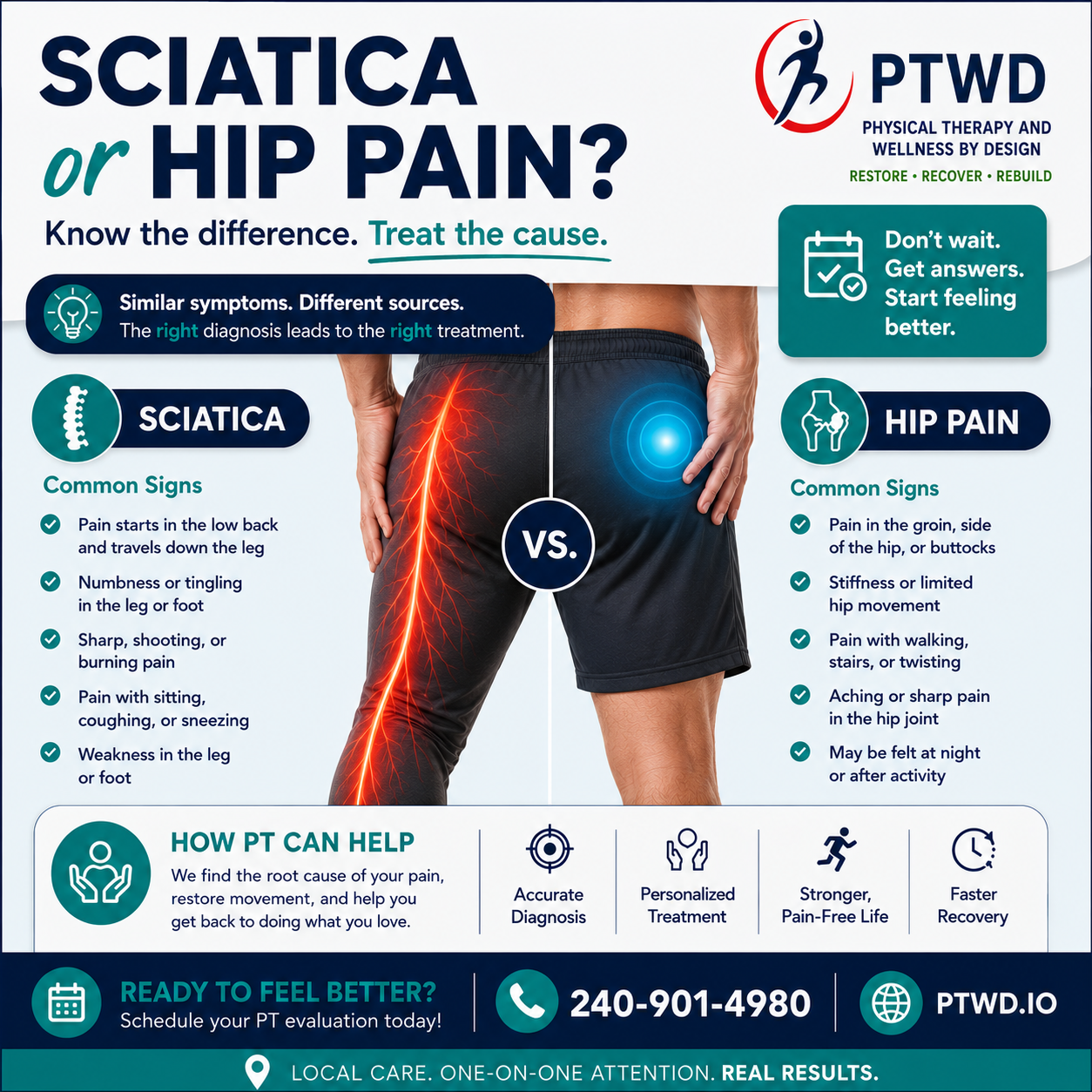
Sciatica is irritation of the sciatic nerve, usually starting in the lower back and traveling through the buttock and down the leg.
Hip pain usually comes from the hip joint or nearby muscles and tendons and is often felt in the groin, front of the hip, or side of the hip.
One simple way to think of it: sciatica is more of a “nerve/wiring” problem, while hip pain is more of a “joint and muscle” problem.
What Is Sciatica?
The sciatic nerve starts in your lower back, runs through your buttock, down the back of your thigh, and into your lower leg and foot. Sciatica happens when that nerve is irritated or compressed.
Common causes include:
A disc bulge or herniation in the lower back
Spinal stenosis (narrowing of the spinal canal)
Arthritis or degenerative changes in the spine
Tight or overactive deep hip muscles (for example, the piriformis)
Because the problem involves a nerve, the pain can travel anywhere along its path.
What Does Sciatica Feel Like?
Typical sciatica symptoms include:
Pain that starts in the lower back or buttock and radiates down the leg
Pain that often travels below the knee, sometimes into the foot
Sharp, shooting, burning, or electric‑like pain
Numbness, tingling, or weakness in the leg or foot
Usually affects one side of the body
Often worse with prolonged sitting, bending forward, coughing, or sneezing
People often describe it as “a lightning bolt down my leg” or “pain that shoots when I move a certain way.”
What Is Hip Joint Pain?
When we talk about hip pain in a medical sense, we usually mean the ball‑and‑socket joint where your thigh bone meets your pelvis, or the surrounding soft tissues.
Common causes of hip pain:
Hip osteoarthritis (wear and tear of the joint)
Labral tears or hip impingement
Bursitis
Tendinitis of the hip muscles
Muscle strains or overuse
Here, the source is local to the joint or nearby tissues, so the pain pattern is more focused than sciatica.
What Does Hip Pain Feel Like?
Typical hip pain symptoms:
Pain in the front of the hip or groin (very common with hip arthritis and labral issues)
Pain on the side of the hip or outer thigh, especially lying on that side
Aching in the buttock or upper thigh
Stiffness and reduced range of motion, especially with walking, getting out of a car, or putting on shoes and socks
Pain that worsens with weight‑bearing activities like walking, standing, or going up stairs
Sometimes clicking or catching sensations in the hip
People with hip joint problems often point to their groin or front of the hip with their whole hand.
Sciatica vs Hip Pain: Key Differences
Here are some quick ways to tell them apart:
Location of pain
Sciatica: Starts in the low back or buttock and travels down the back of the thigh, often below the knee.
Hip pain: Often in the groin, front of hip, or side of hip; may refer to the buttock or upper thigh but usually stays closer to the joint.
Type of pain
Sciatica: Sharp, shooting, burning, electric; may include numbness or tingling.
Hip pain: Deep, aching pain, sometimes sharp with specific movements; tingling and numbness are uncommon.
What makes it worse
Sciatica: Sitting, bending, twisting, coughing, sneezing.
Hip pain: Walking, standing, stairs, lying on that side, or rotating the leg.
Movement limits
Sciatica: Back movements and nerve‑tension positions (like straightening the leg) often reproduce symptoms.
Hip pain: Hip‑joint movements—crossing legs, rotating the leg, putting on shoes—often bring the pain on.
Can Sciatica Cause Pain in the Hip Area?
Yes. Sciatica can be felt in the buttock or hip region because the nerve passes through that area. Hip problems can also cause pain there, which is why it can be confusing.
A few simple clues:
If the pain travels down the leg and feels sharp or electric, sciatica is more likely.
If the pain stays localized around the hip or groin and feels more like stiffness or a deep ache, a hip joint issue is more likely.
It’s also possible to have both at once—for example, hip arthritis and lower back arthritis. That’s one reason a proper, in‑person evaluation is so important.
Red Flag Symptoms: When To Get Help Fast
No article can safely diagnose you. You should seek urgent or emergency care right away if you notice:
Loss of bowel or bladder control
Severe weakness in the leg or foot
Sudden, intense pain after a fall or trauma
Fever, chills, or unexplained weight loss with back or hip pain
Inability to put weight on one leg or walk
These can be signs of a more serious condition that needs immediate medical attention.
How Physical Therapy Can Help
A licensed physical therapist can evaluate your back, hip, and leg to help determine whether your pain is more likely coming from the spine, the hip joint, or both. Based on that, we can create a plan tailored to you.
For sciatica, PT often includes:
Positions and movements that reduce irritation of the nerve
Exercises to improve spinal and hip mobility
Core and hip strengthening for better support
Hands‑on techniques to calm irritated muscles and joints
Guidance on posture and daily activities to prevent flare‑ups
For hip pain, PT often includes:
Exercises to improve hip mobility and reduce stiffness
Strengthening of the glutes and deep hip muscles
Gait and movement retraining (walking, stairs, squatting)
Manual therapy and soft‑tissue work
Load‑management strategies so you can stay active while the hip calms down
In many cases, people can significantly reduce pain and improve function with conservative care.
What You Can Try at Home
These suggestions are general and are not a personal treatment plan:
Stay gently active—short walks and light movement are usually better than complete bed rest.
Avoid positions that clearly flare your symptoms (for example, long sitting for sciatica; deep squats or impact for hip pain).
Try a short trial of ice or heat to see which feels better for you.
Pay attention to your pain pattern—where it starts, where it travels, and what makes it better or worse. Share this with your physical therapist or doctor; it helps them make a more accurate assessment.
If your pain has lasted more than 1–2 weeks, keeps coming back, or is starting to limit your daily life, it’s time to have it evaluated by a physical therapist and/or by a doctor.
How PTWD in Clarksburg Can Help
At Physical Therapy & Wellness by Design (PTWD) in Clarksburg, Maryland, I provide one‑on‑one, customized care for people dealing with sciatica, hip pain, and complex back–hip issues.
Here’s how we help:
A detailed evaluation to sort out whether your pain is primarily from your back, your hip, or both
A clear explanation of what’s going on in language you can understand
A step‑by‑step plan combining hands‑on care and targeted exercises
Flexible evening and weekend appointments to fit your schedule
If you’re within driving distance of our clinic in Clarksburg and you’re not sure where your pain is coming from, you don’t have to figure it out alone. Reach out to PTWD to schedule an evaluation, and we’ll work together to find the safest, most effective path forward.
Neck Pain: Why It Happens, What Helps, and When to Get It Checked ✅

Physical Therapy & Wellness by Design | Clarksburg, MD
⚠️ Disclaimer
This content is for educational purposes only and is not intended as medical advice. It does not establish a provider–patient relationship. Please consult with a licensed healthcare professional before starting any exercise program or making healthcare decisions, especially if pain, injury, or medical conditions are present.
🧠 What Neck Pain Usually Means
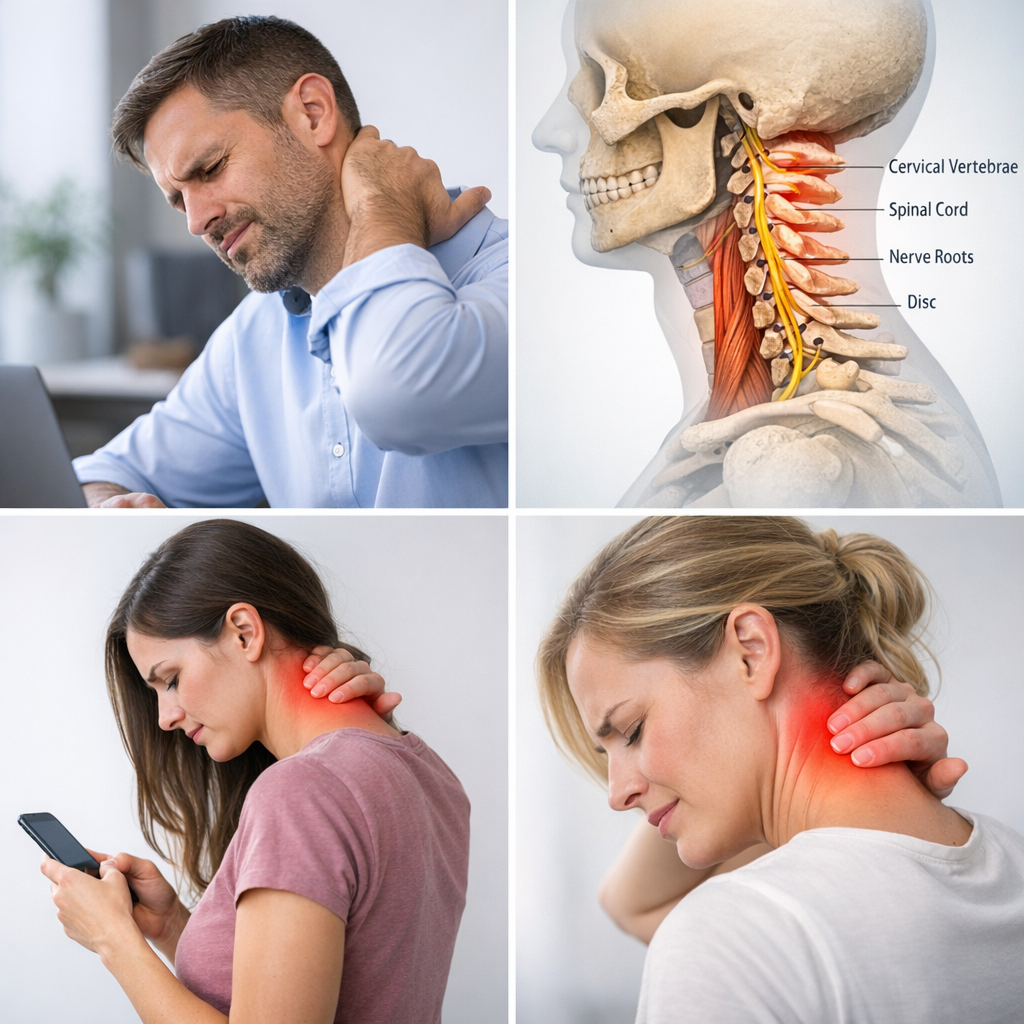
Neck pain is a common concern and is often associated with muscle tension, joint stiffness, postural strain, or repetitive loading. In many cases, symptoms develop gradually rather than from a single injury.
Some common contributing factors may include, but are not limited to:
💻 Prolonged desk or computer work
📱 Repeated looking down at phones or tablets (“tech neck”)
🧳 Carrying bags on one shoulder
😴 Sleeping positions or pillow support that do not adequately support the neck
🏋️ Sudden increases in physical activity or lifting demands
🚗 Extended driving or commuting
🦴 Understanding the Neck (Cervical Spine)
The neck—also known as the cervical spine—is designed to provide both mobility and stability. It supports the weight of the head and works closely with the upper back, shoulders, and nervous system.
Structures that may contribute to neck symptoms include:
🧩 Joints, which may become stiff with prolonged or repetitive positions
💪 Muscles, including the upper trapezius, levator scapulae, and deep neck muscles
🧠 Nerves, which may be involved when symptoms extend into the shoulder or arm
🧱 Upper back and shoulder blades, which can influence how much stress the neck experiences
👉 Important: Neck symptoms are often influenced by multiple regions, not the neck alone.
🚩 Symptoms That Warrant Professional Evaluation

Consider seeking evaluation from a licensed healthcare professional if you experience:
⚡ Pain radiating into the arm with numbness or tingling
💪 New or progressive weakness
🌪️ Dizziness, imbalance, or visual changes associated with neck movement
🤕 Severe, persistent, or unusual headaches
🚗 Symptoms following a fall, accident, or trauma
🌡️ Fever, unexplained weight loss, or night sweats
⏳ Pain that continues to worsen or does not improve over 48 hours
🔥 A Common Neck Discomfort Pattern
Some individuals report:
🧱 Tightness across the upper shoulders or stiffness in the neck
🎯 Discomfort near the base of the skull or top of the shoulder
🔄 Symptoms that increase with prolonged sitting, computer use, or driving
😌 Temporary symptom changes with movement that return after sustained positions
This presentation is commonly associated with postural stress and movement habits, though individual experiences may vary.
🛠️ General Strategies That May Be Helpful
Some people may find symptom relief by incorporating general movement and posture awareness into daily routines, such as:
⏱️ Taking brief movement breaks every 30–45 minutes
🖥️ Positioning screens closer to eye level
🪑 Sitting with appropriate back and arm support
🧊 or 🔥 Using ice or heat based on individual comfort
🚶 Engaging in light, regular movement
Responses to these strategies differ between individuals.
🧘 Exercises You Can Try
The following exercises are commonly used in physical therapy settings and are provided for general educational purposes only. Perform slowly and within a comfortable range. Discontinue if symptoms worsen.
Chin Tucks

⏱️ 30 seconds × 4
Sit tall with shoulders relaxed
Gently glide your chin straight back
Keep your eyes level (do not look down)
✅ Upper Trapezius Stretch

⏱️ 30 seconds × 4, both sides
Sit tall and hold the chair seat with one hand
Gently tilt your head away from that side
Add light pressure only if comfortable
✅ Levator Scapula Stretch

⏱️ 30 seconds × 4, both sides
Sit upright with shoulders relaxed
Rotate your head about 45° away from the side being stretched
Now gently pull your head towards your arm pit and add gentle pressure only if comfortable (no side bending)
Breathe slowly
🧩 A Physical Therapy Perspective
Physical therapy for neck-related symptoms typically involves:
✔️ Individualized evaluation of movement, posture, and contributing factors
✔️ Addressing joint and muscle mobility as appropriate
✔️ Improving strength, coordination, and movement control
✔️ Education on activity modification and self-management strategies
Maryland Direct Access Note
Under Maryland law, individuals may access physical therapy services without a physician referral, within the scope permitted by state regulations. A physical therapist will determine whether physical therapy services are appropriate or if referral to another healthcare provider is recommended.
At Physical Therapy & Wellness by Design, care is based on professional evaluation, clinical judgment, and patient-specific needs.
📍 When to Consider Scheduling an Evaluation
If neck symptoms are persistent, recurring, or interfering with daily activities, an evaluation with a licensed physical therapist may help clarify appropriate next steps.
🟦 Physical Therapy & Wellness by Design
📍 Clarksburg, MD
📞 240-901-4980
👉 Schedule / Contact
✍️ Author
Dr. Vardhan K. Mudigonda, PT, DPT
Doctor of Physical Therapy
Physical Therapy & Wellness by Design (PTWD) – Clarksburg, MD
Physical Therapist providing one-on-one, movement-based care for athletes and active adults. Restore-Recover and Rebuild
⚠️ Disclaimer
This content is for educational purposes only and is not intended as medical advice. It does not establish a provider–patient relationship. Please consult with a licensed healthcare professional before starting any exercise program or making healthcare decisions, especially if pain, injury, or medical conditions are present.
🎾🏐🏸 Shoulder Pain in Racquet & Overhead Sports
It all begins with an idea.

When Repetitive Overhead Play Overloads the Rotator Cuff
⚠️ Disclaimer
This content is for educational purposes only and is not intended as medical advice. It does not establish a provider–patient relationship. Please consult with a licensed healthcare professional before starting any exercise program or making healthcare decisions, especially if pain, injury, or medical conditions are present.
🔵 Why Racquet & Overhead Sports Commonly Cause Shoulder Pain
Sports such as pickleball, tennis, badminton, squash, volleyball, and overhead gym activities place repeated stress on the shoulder through serving, smashing, reaching, and rapid reaction movements.
Shoulder pain during these activities is often not a sign of weakness, but rather an early warning sign of tissue overload or movement dysfunction. If ignored, symptoms can progress to prolonged pain, loss of performance, or time away from sport.
As a Physical Therapist, early identification of the source of shoulder pain allows for appropriate triage, targeted rehabilitation, and prevention of more significant injury.
🟠 Common Contributors to Shoulder Pain in Overhead Sports
The shoulder is exposed to repetitive overhead and rotational stress, often under fatigue. Common contributing factors include:
• Repetitive overhead serving or smashing with insufficient rotator cuff endurance
• Poor scapular (shoulder blade) control during fast volleys or reaction shots
• Reduced load tolerance of the supraspinatus and infraspinatus tendons
• Limited thoracic (upper back) mobility, altering shoulder mechanics
• Sudden increases in playing frequency, duration, or intensity
These factors increase compressive and shear forces at the shoulder joint, resulting in pain, irritation, or loss of movement control.
🔴 Pain Is a Warning Signal — Not Simply “Weakness”
Shoulder pain is commonly mislabeled as weakness. In reality, pain often reflects:
• Tendon overload rather than muscle failure
• Poor coordination between the rotator cuff and shoulder blade muscles
• Altered motor control during fast or repetitive arm movements
• Fatigue-related breakdown of movement quality late in play
Continuing to “push through” pain without addressing these issues increases the risk of tendinopathy, bursitis, or partial rotator cuff injury.
🟡 Early Signs That Deserve Assessment
Consider a professional evaluation if you experience:
• Pain with overhead serves, smashes, or reaching
• Discomfort during quick volleys or reaction shots
• Night pain or soreness after play
• Decreasing power, control, or endurance
• Pain lasting longer than 48–72 hours
Early assessment helps determine whether symptoms are due to irritation, overload, or structural involvement—and whether imaging or medical referral is needed.
🟢 Gentle Shoulder Exercises to Try First
(For mild, recent symptoms only)
These low-load exercises may help support shoulder mechanics and reduce irritation. They are meant to support recovery, not replace a comprehensive evaluation.
✅ 1. Backward Shoulder Rolls
20 repetitions
• Encourages gentle mobility and postural awareness
• Helps unload stress on the supraspinatus tendon (part of the rotator cuff)
How to perform:
Take a deep breath and relax
UP: Shrug shoulders toward your ears
BACK: Squeeze shoulder blades together
Hold briefly with good posture
DOWN: Lower shoulders while staying upright
✅ 2. Scapular Retraction Holds
Hold 5 seconds × 20 repetitions
• Improves shoulder blade stability, essential for overhead sports
How to perform:
Elbows bent and tucked at your sides
Draw shoulder blades down and back
Imagine pinching a tennis ball between them
✅ 3. Isometric Shoulder External Rotation
Hold 5 seconds × 20 repetitions
• Activates the rotator cuff with minimal joint stress
How to perform:
Stand upright holding a resistance band
Elbows at sides, bent to 90°, thumbs facing outward
Gently pull hands apart while squeezing shoulder blades down and together
🔵 Why Early Physical Therapy Matters
Addressing shoulder pain early can:
• Reduce the risk of chronic tendon irritation
• Restore efficient movement mechanics
• Improve tolerance to overhead loading
• Prevent unnecessary imaging or injections
• Keep athletes active, confident, and performing well
As a Physical Therapist, I use a movement-based, evidence-informed approach and coordinate referral when imaging or orthopedic consultation is appropriate.
🔴 When to Seek Professional Care
If pain persists, worsens, or limits your ability to play despite rest and basic exercises, a comprehensive physical therapy evaluation is recommended. Shoulder pain should not be accepted as “just part of the sport.”
🏥 Physical Therapy & Wellness by Design (PTWD)
📍 Clarksburg, Maryland
📞 240-901-4980
✔ One-on-one, individualized care
✔ Direct access to a Doctor of Physical Therapy
✔ Early assessment. Targeted rehabilitation. Smarter return to play.
✍️ Author
Dr. Vardhan K. Mudigonda, PT, DPT
Doctor of Physical Therapy
Physical Therapy & Wellness by Design (PTWD) – Clarksburg, MD
Physical Therapist providing one-on-one, movement-based care for athletes and active adults. Restore-Recover and Rebuild
⚠️ Disclaimer
This content is for educational purposes only and is not intended as medical advice. It does not establish a provider–patient relationship. Please consult with a licensed healthcare professional before starting any exercise program or making healthcare decisions, especially if pain, injury, or medical conditions are present.