
🎾🏐🏸 Shoulder Pain in Racquet & Overhead Sports
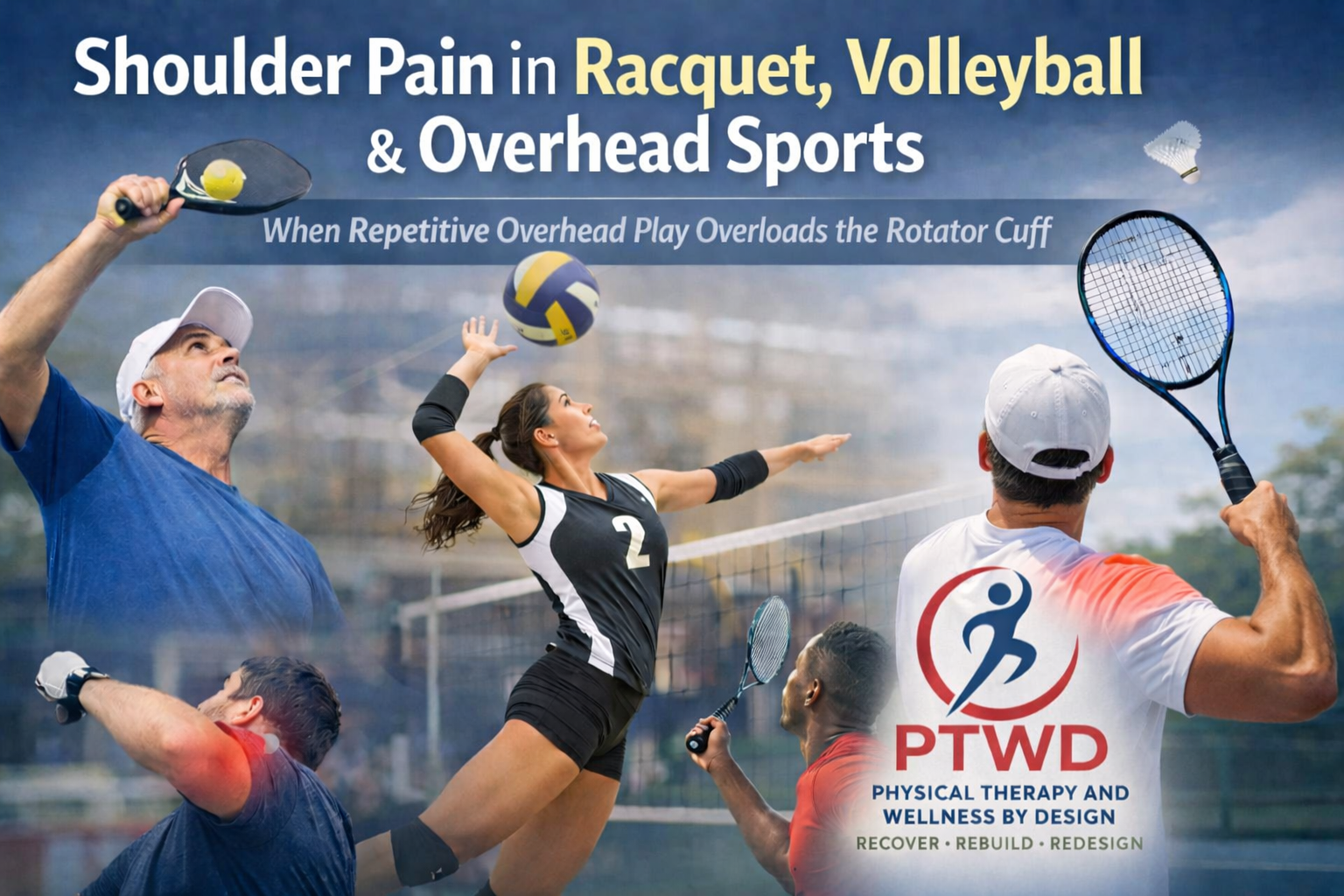
When Repetitive Overhead Play Overloads the Rotator Cuff
⚠️ Disclaimer
This content is for educational purposes only and is not intended as medical advice. It does not establish a provider–patient relationship. Please consult with a licensed healthcare professional before starting any exercise program or making healthcare decisions, especially if pain, injury, or medical conditions are present.
🔵 Why Racquet & Overhead Sports Commonly Cause Shoulder Pain
Sports such as pickleball, tennis, badminton, squash, volleyball, and overhead gym activities place repeated stress on the shoulder through serving, smashing, reaching, and rapid reaction movements.
Shoulder pain during these activities is often not a sign of weakness, but rather an early warning sign of tissue overload or movement dysfunction. If ignored, symptoms can progress to prolonged pain, loss of performance, or time away from sport.
As a Physical Therapist, early identification of the source of shoulder pain allows for appropriate triage, targeted rehabilitation, and prevention of more significant injury.
🟠 Common Contributors to Shoulder Pain in Overhead Sports
The shoulder is exposed to repetitive overhead and rotational stress, often under fatigue. Common contributing factors include:
• Repetitive overhead serving or smashing with insufficient rotator cuff endurance
• Poor scapular (shoulder blade) control during fast volleys or reaction shots
• Reduced load tolerance of the supraspinatus and infraspinatus tendons
• Limited thoracic (upper back) mobility, altering shoulder mechanics
• Sudden increases in playing frequency, duration, or intensity
These factors increase compressive and shear forces at the shoulder joint, resulting in pain, irritation, or loss of movement control.
🔴 Pain Is a Warning Signal — Not Simply “Weakness”
Shoulder pain is commonly mislabeled as weakness. In reality, pain often reflects:
• Tendon overload rather than muscle failure
• Poor coordination between the rotator cuff and shoulder blade muscles
• Altered motor control during fast or repetitive arm movements
• Fatigue-related breakdown of movement quality late in play
Continuing to “push through” pain without addressing these issues increases the risk of tendinopathy, bursitis, or partial rotator cuff injury.
🟡 Early Signs That Deserve Assessment
Consider a professional evaluation if you experience:
• Pain with overhead serves, smashes, or reaching
• Discomfort during quick volleys or reaction shots
• Night pain or soreness after play
• Decreasing power, control, or endurance
• Pain lasting longer than 48–72 hours
Early assessment helps determine whether symptoms are due to irritation, overload, or structural involvement—and whether imaging or medical referral is needed.
🟢 Gentle Shoulder Exercises to Try First
(For mild, recent symptoms only)
These low-load exercises may help support shoulder mechanics and reduce irritation. They are meant to support recovery, not replace a comprehensive evaluation.
✅ 1. Backward Shoulder Rolls
20 repetitions
• Encourages gentle mobility and postural awareness
• Helps unload stress on the supraspinatus tendon (part of the rotator cuff)
How to perform:
Take a deep breath and relax
UP: Shrug shoulders toward your ears
BACK: Squeeze shoulder blades together
Hold briefly with good posture
DOWN: Lower shoulders while staying upright
✅ 2. Scapular Retraction Holds
Hold 5 seconds × 20 repetitions
• Improves shoulder blade stability, essential for overhead sports
How to perform:
Elbows bent and tucked at your sides
Draw shoulder blades down and back
Imagine pinching a tennis ball between them
✅ 3. Isometric Shoulder External Rotation
Hold 5 seconds × 20 repetitions
• Activates the rotator cuff with minimal joint stress
How to perform:
Stand upright holding a resistance band
Elbows at sides, bent to 90°, thumbs facing outward
Gently pull hands apart while squeezing shoulder blades down and together
🔵 Why Early Physical Therapy Matters
Addressing shoulder pain early can:
• Reduce the risk of chronic tendon irritation
• Restore efficient movement mechanics
• Improve tolerance to overhead loading
• Prevent unnecessary imaging or injections
• Keep athletes active, confident, and performing well
As a Physical Therapist, I use a movement-based, evidence-informed approach and coordinate referral when imaging or orthopedic consultation is appropriate.
🔴 When to Seek Professional Care
If pain persists, worsens, or limits your ability to play despite rest and basic exercises, a comprehensive physical therapy evaluation is recommended. Shoulder pain should not be accepted as “just part of the sport.”
🏥 Physical Therapy & Wellness by Design (PTWD)
📍 Clarksburg, Maryland
📞 240-901-4980
✔ One-on-one, individualized care
✔ Direct access to a Doctor of Physical Therapy
✔ Early assessment. Targeted rehabilitation. Smarter return to play.
✍️ Author
Dr. Vardhan K. Mudigonda, PT, DPT
Doctor of Physical Therapy
Physical Therapy & Wellness by Design (PTWD) – Clarksburg, MD
Physical Therapist providing one-on-one, movement-based care for athletes and active adults. Restore-Recover and Rebuild
⚠️ Disclaimer
This content is for educational purposes only and is not intended as medical advice. It does not establish a provider–patient relationship. Please consult with a licensed healthcare professional before starting any exercise program or making healthcare decisions, especially if pain, injury, or medical conditions are present.